35 Berkeley Square
London W1J 5BF
United Kingdom
Company Number: 09747305
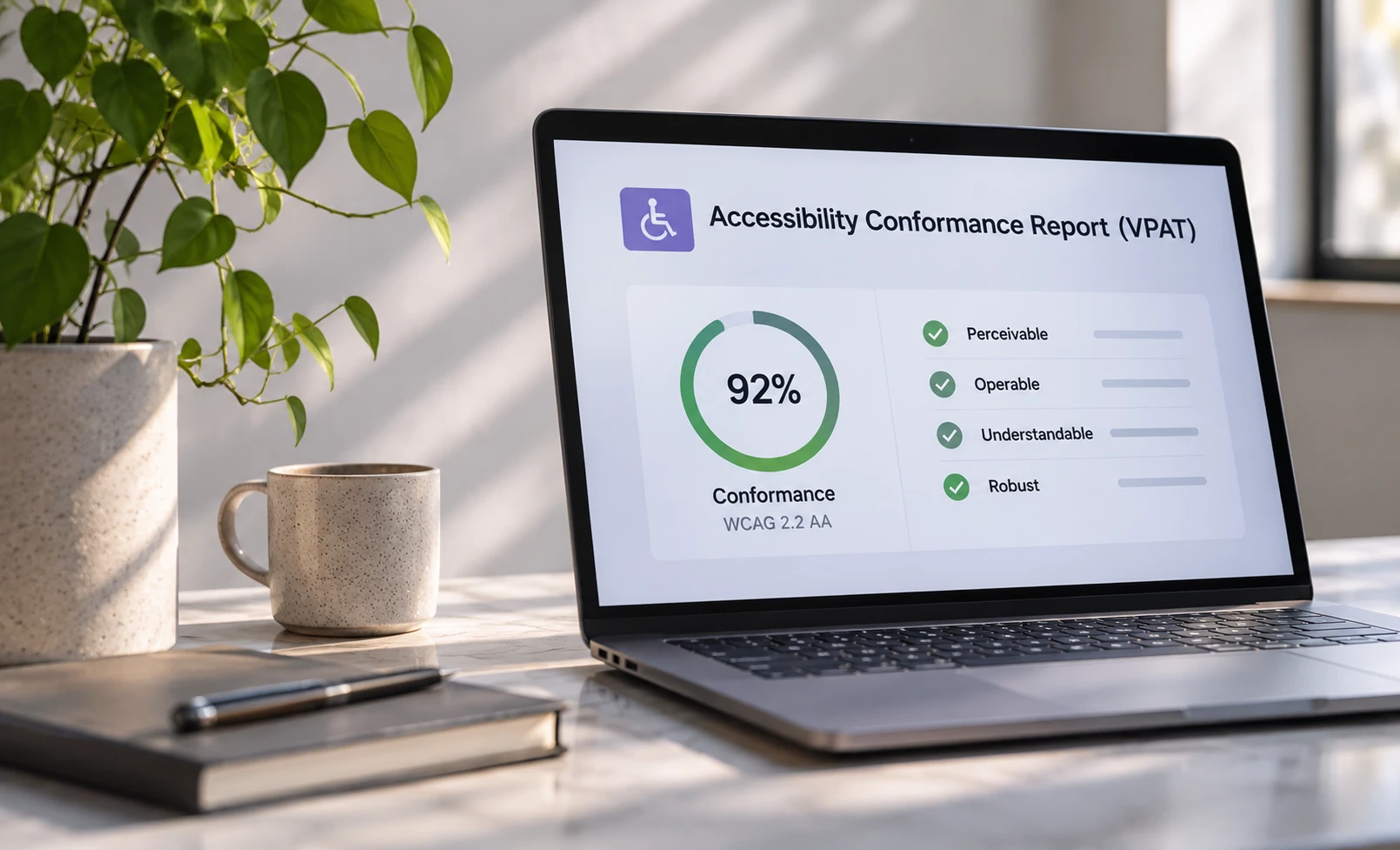

A client sends a questionnaire, and somewhere on page three is the line: "Please provide a current VPAT for the product." It looks just like some paperwork to do, but it isn't.
For public-sector buyers, and for the banks, asset managers and universities that follow their lead, the Accessibility Conformance Report (ACR) is often the only evidence they have that your product will work for people with disabilities. They read it to judge risk, and some score it. In Texas, for example, state buyers rate the credibility of vendors' accessibility documents on a 0-3 scale as part of the bid.
A credible ACR is specific, honest and verifiable. It names the exact product version it covers, explains how it was tested, admits where the product falls short, and describes each gap well enough that the buyer can judge its impact. A report that says "Supports" in every row usually convinces no one.
The two terms get used interchangeably, but they aren't the same thing.
The VPAT (Voluntary Product Accessibility Template) is a blank template published by the Information Technology Industry Council (ITI). There are four editions: WCAG, Revised Section 508 (US federal), EU (EN 301 549) and International, which combines all three.
The ACR (Accessibility Conformance Report) is what you get when you fill in that template for one specific product and version. This is the document the buyer actually reads.
Two facts surprise many vendors. First, there is no such thing as VPAT certification: ITI offers no certificate or compliance logo. Second, the ACR is a self-declaration. Nobody checks it before it reaches the buyer, which is exactly why buyers have learned to check it themselves.
An experienced procurement or accessibility reviewer rarely reads an ACR from top to bottom. They skim for signals:
The title page.
Product name, version, report date, who tested it and how. Missing fields end the review early.
The pattern of results.
A complex web platform with "Supports" in all 50 WCAG 2.1 A and AA rows is statistically unlikely. Reviewers know this.
The remarks on known weak spots.
Keyboard access, focus order, form labels, error messages, colour contrast, data tables. These are where most products fail, so this is where reviewers look first.
Whether it matches reality.
Some buyers open the product and try a few things with a keyboard or screen reader. If the ACR says "Supports" and the login form can't be reached by Tab, the whole document loses credibility.
In short: the buyer isn't looking for a perfect score. They're looking for a report they can trust.
1. It covers one product, version and date
A credible ACR names the exact product and release it describes, such as "Investor Portal v4.2, tested October 2026". A report for "our platform" with no version, or one dated 2023 for a product that has shipped twenty releases since, tells the buyer nothing about what they're buying today.
Many reviewers treat reports older than two years as unreliable.
2. It uses properly the current template
Use a current ITI template (VPAT 2.5Rev at the time of writing) and the edition your buyer asked for: Section 508 for US federal, WCAG or International for most US state, local and private buyers, EU for European ones. Delete the instruction pages, fill in every title-page field, and make the ACR document itself accessible. An inaccessible accessibility report is an awkward start.
3. It explains how the product was tested
The "Evaluation methods" field is where credibility is won or lost. "Automated scan" isn't enough, because automated tools catch only around 30-40% of accessibility issues.
A strong ACR lists:
the automated tools used (for example axe DevTools, WAVE)
manual testing: keyboard-only navigation, zoom and 200% text, mobile at 320 px width
the assistive technology and browser combinations (for example NVDA with Chrome on Windows, VoiceOver with Safari on macOS and iOS)
which user journeys were tested: login, onboarding, transactions, reports
who tested it, and whether they were independent of the build team
4. It uses only the official conformance terms
There are four: Supports, Partially Supports, Does Not Support and Not Applicable. ("Not Evaluated" is allowed only for optional Level AAA criteria.)
Invented phrases such as "Mostly compliant", "Supports with exceptions" or "In progress" are an immediate red flag for experienced reviewers.
5. It's honest about gaps
This is the counter-intuitive one. "Partially Supports" with a clear remark is more convincing than "Supports" everywhere. Every real product has issues. Buyers know it, and an all-green report suggests either light testing or optimistic writing. Honesty also protects you: if a buyer later finds a barrier your ACR claimed didn't exist, that gap becomes a contractual and reputational problem.
6. Its remarks are specific enough to act on
Weak: "Some images may be missing alternative text."
Strong: "Partially Supports. Fund performance charts on the Portfolio page have no text alternative; screen-reader users can't access the figures. The same data is available in the table below each chart. Text alternatives are scheduled for release 4.3 (Q1 2027)."
A good remark answers four questions: where the issue is, what fails, whom it affects, and whether there's a workaround or a fix date.
7. It's backed by evidence and a plan
The most credible vendors can answer the follow-up question: "Can we see the test results?" Behind a strong ACR sits an audit report mapped to WCAG success criteria, retest results after fixes, and a remediation roadmap with dates. Some buyers will ask for all three, and having them ready shortens the procurement conversation considerably.
Red flag | What the buyer concludes |
"Supports" in every row | The product wasn't really tested |
No evaluation methods or "automated scan" only | Most real barriers were never checked |
No product version or an old date | It describes a product that no longer exists |
Made-up conformance terms | The author doesn't know the standard |
"Partially Supports" with no remark | The vendor is hiding the detail |
Mentions an overlay or widget as the fix | The underlying code isn't accessible |
Generated by AI with no expert review | Nobody can stand behind the claims |
You can write it yourself, but only if your team includes people who test with assistive technology every day. Otherwise, an independent evaluation is usually worth it: it's more objective, and buyers give it more weight.
AI tools can help you spot likely problem areas before a formal review. They shouldn't write the final report. An ACR is a statement your company signs, so a qualified person needs to have tested what it claims.
At Authentic Digital, the ACR is the last step of the work, not the first. We build financial portals and platforms with our clients' delivery teams, and that's how we produce reports:
Audit: automated scans plus manual keyboard, screen-reader and mobile testing across your key user journeys.
Fix: we work with your developers to resolve issues in the code, prioritised by severity and user impact.
Retest: we verify every fix, so the report describes the product as it is now.
Document: we prepare the ACR in the edition your buyer needs, with specific remarks and a full evaluation-methods section.
Support acceptance: we help answer your buyer's follow-up questions and provide supporting evidence.
Keep it current: we retest after major releases, so your ACR doesn't go out of date the moment you ship.
Is a VPAT legally required?
Not by itself. But US federal agencies expect one under Section 508, many state and local buyers and universities require one in procurement, and a growing number of private enterprise buyers ask for one too.
How long does an ACR take?
It depends on the product's size and how accessible it is already. Testing a mid-sized web application typically takes a few weeks. Fixing issues before you publish the report takes longer. [Confirm typical timelines with the delivery team.]
How often should we update it?
After any significant release, when the standards or template change, and at least once a year.
Can we share an ACR that shows gaps?
Yes, and you should. A report with honest "Partially Supports" entries and a fix plan is more credible than one that claims perfection.
Which edition should we use?
The one your buyer asks for. If they don't specify, the International edition covers WCAG, Section 508 and EN 301 549 in one document.
Let's talk and figure out what can be done.
Learn how we have managed to aid business initiatives around software products

WCAG is a recognized standard providing a framework for creating accessible digital content. By June 28, 2025, all companies within the EU should incorporate it.

During one of our audits of a financial portal, the screen looked clean. WAVE reported zero errors. axe DevTools reported zero errors. By the numbers, the page was done. Then our accessibility engineer put the mouse aside and pressed Tab...
Let’s talk about your project - we will convince you that we have right people, skills and experience.