35 Berkeley Square
London W1J 5BF
United Kingdom
Company Number: 09747305


Your sales team forwards an email from a customer asking for a VPAT. They need it as part of their procurement process.
The problem is that you're not entirely sure what a VPAT is, whether your company already has one or how much work might be involved in producing it.
If that sounds familiar, the good news is that you may already have some of the information you need.
A VPAT (Voluntary Product Accessibility Template) is a template developed by the Information Technology Industry Council (ITI). It provides a structured way of documenting how a software product supports particular accessibility standards.
Once the template has been completed with the results of an evaluation, it becomes an Accessibility Conformance Report, or ACR.
Customers frequently use the term VPAT when referring to the completed report. That's the document they're usually expecting to receive, rather than the blank template.
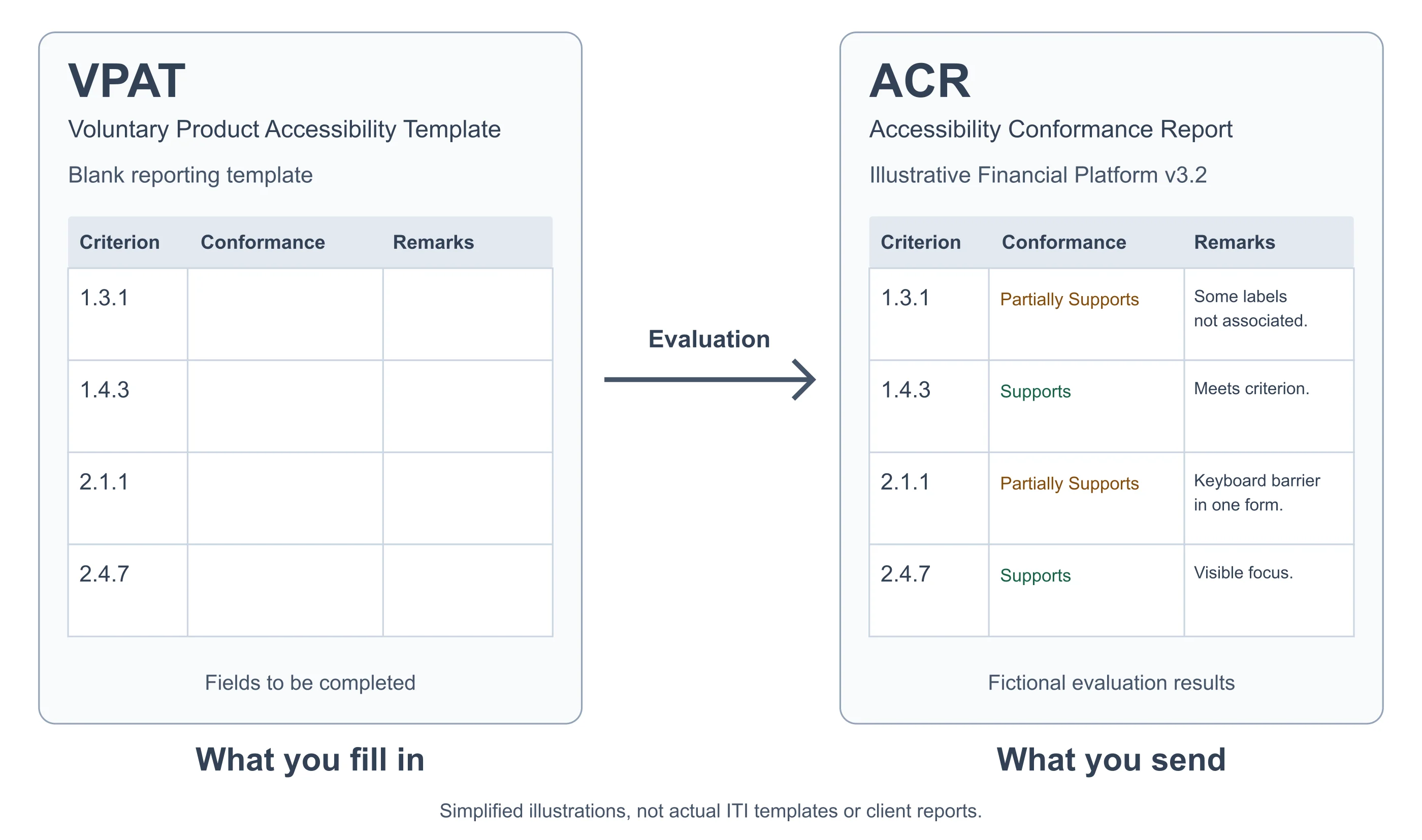
An ACR doesn't necessarily mean that a product is fully accessible. It can also document areas where the product only partially supports a particular accessibility criterion or doesn't support it at all.
This is useful to know, particularly if your development team is still working on accessibility improvements.
Before commissioning an accessibility evaluation, it's worth finding out what work has already been done.
Your product may have been evaluated for another customer, as part of an earlier procurement process or during a previous development project. The results might sit with your QA team, product management, compliance or the people responsible for responding to tenders.
When looking through your company's documentation, search for both VPAT and ACR.
You might come across an accessibility audit rather than a completed report. Although they're different documents, the audit could contain evaluation results that your team can use when preparing an ACR.
If nobody has prepared one before, we've put together a separate guide on How to Prepare Your First Accessibility Conformance Report.
Finding an existing ACR is a good start. The next question is whether you can actually use it.
Imagine your team finds a report issued three months ago. That sounds reasonably recent.
However, since the application was evaluated, you've introduced a new interactive data grid and replaced some of the form components. Your prospective customer will be using the latest release.
The date on the report may tell you very little about whether the new functionality has been evaluated.
I'd compare the report with the release and configuration that the customer will receive. Your release notes and development team should help establish whether anything relevant has changed.
It's also worth checking whether the customer's accessibility requirements match the standard and scope covered by your existing report.
We've explored these questions in more detail in When to Update Your Accessibility Conformance Report.
1. You have a report that covers the customer's requirements.
This is relatively straightforward. Having confirmed the product version, scope and reporting requirements, you can share the document with a short explanation of what it covers.
2. You have a report, but it doesn't cover everything the customer will receive.
Perhaps the customer will be using functionality introduced after your previous evaluation.
You may still have useful evidence to share. The important thing is to make clear which parts of the proposed product the report describes and which require further investigation.
3. You don't have a completed report.
That doesn't necessarily mean you're starting from scratch. Previous evaluations, test results and records of accessibility improvements could provide a useful foundation.
Before promising a delivery date for the ACR, establish what the customer expects and what still needs to be evaluated.
Our article on estimating accessibility work before committing to a delivery date explains why this can involve considerably more than preparing a document.
You have the right report |
Hi [name], Thanks for sending this through. I've attached our Accessibility Conformance Report for [product, release and configuration]. It covers [evaluated scope]. Please let me know if there are any particular workflows or accessibility requirements you'd like us to discuss. |
Your report covers a different version or configuration |
Hi [name], We have an Accessibility Conformance Report for [evaluated release or configuration]. The proposed version also includes [additional or changed functionality], which isn't covered by the current report. We're reviewing what existing evaluation results we can reuse and what requires additional testing. Could you please confirm when you need the evidence for these areas? |
You're preparing your first report |
Hi [name], We don't currently have a completed Accessibility Conformance Report for [product]. To make sure we're addressing the right requirements, could you please confirm the accessibility standard, version and level you expect, along with any specific reporting or independent evaluation requirements? It would also be helpful to know when you need the report. In the meantime, we're reviewing the accessibility evidence we already have and will come back to you with an update by [agreed date]. |
There are six things I'd want to have reasonably clear before responding to a VPAT request:
☐ Existing report. Do we already have an ACR for this product, and who owns it?
☐ Product version. Which release and configuration were evaluated?
☐ Coverage. Does the evaluation include the functionality and generated documents the customer will use?
☐ Changes. Has anything relevant changed since the evaluation, and do we have updated test results?
☐ Requirements. Which standard, version, level and reporting format does the customer expect? Is independent evaluation required?
☐ Deadline. When does the customer need the report, and would they accept an interim update?
You don't necessarily need to have every answer before acknowledging the customer's email. You do need to understand what you can confirm today and what requires further investigation.
If you've just received your first VPAT request and aren't quite sure what sits behind it, that's something our team deals with regularly when working on financial applications.
If your AI has approved access to your company's product documentation, previous evaluations and the customer's requirements, it can help you prepare an initial response.
Alternatively, provide the relevant excerpts using an AI tool approved by your organisation.
A customer has asked us for a VPAT or Accessibility Conformance Report.
Review the customer's request, the proposed product release and configuration, and any existing accessibility reports or evaluation results I provide.
Identify what we can confidently confirm today, what the existing evidence covers, and what still requires clarification or evaluation.
Pay particular attention to differences between the evaluated product and the one we are offering, the requested accessibility standard, reporting format, independence requirements and deadline.
Draft a customer reply of no more than 120 words. Use only confirmed facts. Do not claim conformance, promise delivery dates or refer to attachments unless the information provided supports those statements.
Separately, list the questions our product or accessibility team still needs to answer.
Learn how we have managed to aid business initiatives around software products
A client sends a questionnaire, and somewhere on page three is the line: "Please provide a current VPAT for the product." It looks just like some paperwork to do, but it isn't.

WCAG is a recognized standard providing a framework for creating accessible digital content. By June 28, 2025, all companies within the EU should incorporate it.

During one of our audits of a financial portal, the screen looked clean. WAVE reported zero errors. axe DevTools reported zero errors. By the numbers, the page was done. Then our accessibility engineer put the mouse aside and pressed Tab...
Let’s talk about your project - we will convince you that we have right people, skills and experience.